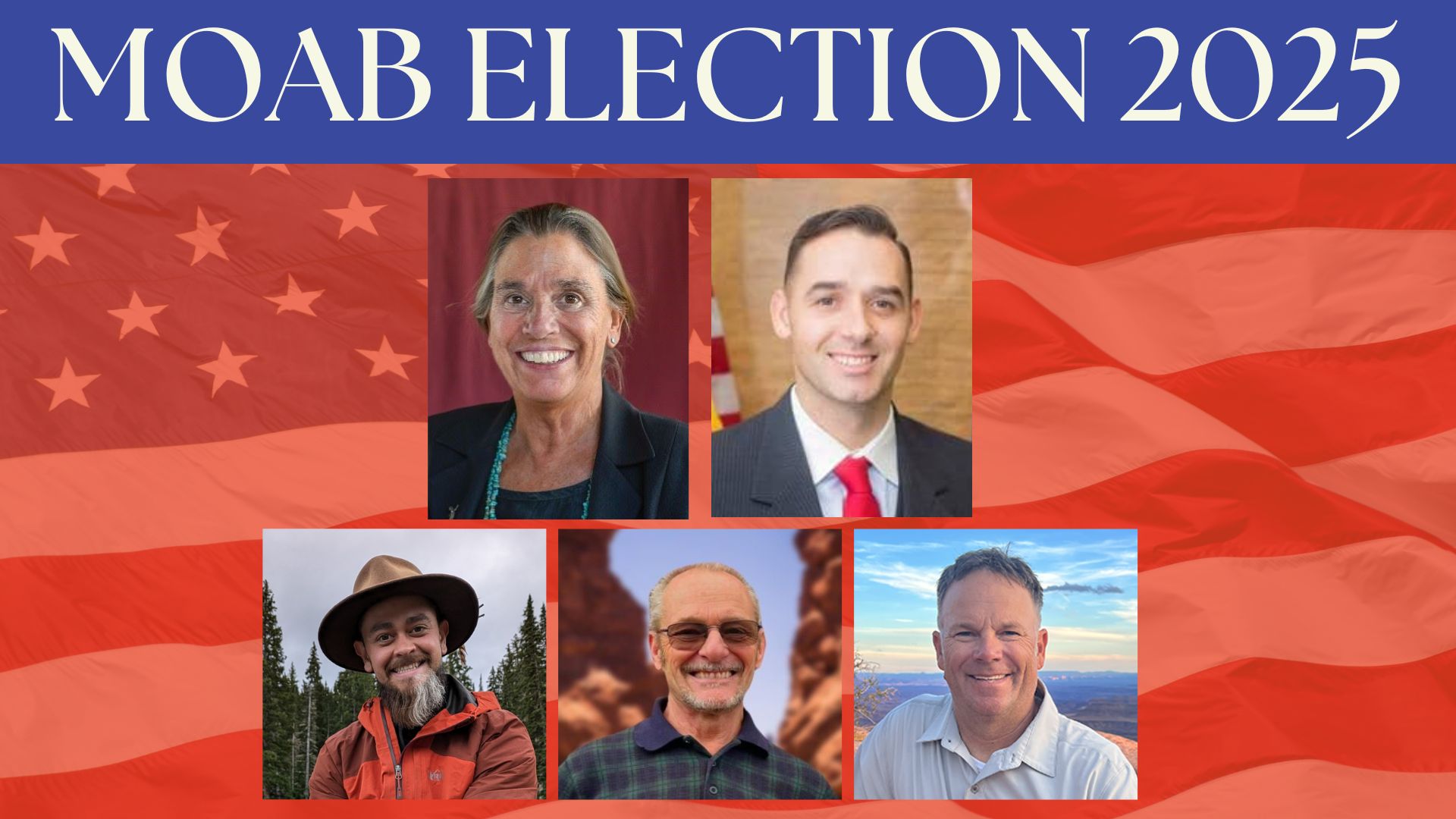
During the recent League of Women Voters candidate forum, mayoral and council candidates made a number of claims about city finances, taxes, housing, and local services. Here’s a closer look at some of the statements and the facts behind them.
All five candidates emphasized that housing and infrastructure are pressing challenges for Moab. All pointed to the strain from repeated flooding and the difficulty workers face in finding housing. All agreed that Moab has grown more complex in recent years.
The sharpest disagreements came over finances. Curtis Wells and Howard Trenholme criticized Moab’s 2022 property tax, saying it was unnecessary or misused, while Joette Langianese and Jason Taylor defended it as essential to fund long-deferred infrastructure and to give Moab the stability to borrow responsibly for future projects. Miles Loftin largely sidestepped the tax fight and focused on exploring housing tools such as voluntary deed restrictions.
The candidates also differed on the role of city government. Wells described the city budget as bloated, while Langianese argued that investments in staffing gaps were needed. Trenholme proposed bold steps like declaring a housing emergency, while others were more cautious about sweeping measures. Loftin and Taylor spoke about specific housing programs, while Wells questioned the effectiveness of the city’s past housing efforts, including the stalled Walnut Lane housing project.
Mayoral Candidate: Joette Langianese
Claim: When she took office, the city had only 7 police employees (budgeted for 20), and no city manager or legal staff.
Moab lacked a city manager or attorney after Joel Linares and Laurie Simonson resigned that September. Those vacancies created a gap until replacements were hired in 2022. Police staffing was also far below budgeted levels.
Moab temporarily lacked a city attorney and city manager at the time Langianese was sworn in.
Claim: The council’s property tax funds only capital improvements deferred for 30 years.
The 2022 tax brings in about $2 million annually which is legally restricted to capital projects. Critics note a future council could redirect funds, but to date the money has supported capital projects like storm drainage and roadway work.
Claim: Four flash floods during her term required new flood planning.
Floods in 2021–23 caused major damage to the city and local businesses. A city engineer’s estimate for after the 2022 flood put the estimated total cost for flood recovery, including debris removal, road and bridge damage, water control facilities damage, utilities damage, and recreation facility damage for just that flood at around $17,600,000. The city has since prioritized projects including improvements to Mill Creek drainage, upgrades to the 400 East stormwater system, and retention basins near Kane Creek Boulevard.
Major flood mitigation projects are in the pipeline for 2025–27.
Mayoral Candidate: Curtis Wells
Claim: The city budget has doubled in the past decade.
Moab’s general fund expenditures in FY2013 were about $6.5 million. By FY2024, the budget was closer to $13 million. General fund revenues rose in parallel, from about $6.8 million in 2013 to more than $13 million in 2024, mostly from sales and resort taxes tied to booming visitation.
> Compare the Moab City budget from 2022 to the projected 2026 budget.
Moab City spending has doubled, but revenues doubled too.
Claim: The property tax was put on the ballot and failed, then later enacted “in a quiet summer month.”
At the debate, Wells said voters rejected a property tax before the council adopted one; that didn’t happen. After the debate, Wells acknowledged the “failed” effort was instead a no-vote by the council in 2021, not voters.
A property tax was considered in 2021 but the Moab City Council decided not to proceed. The next year, the Council held a truth-in-taxation meeting and approved a tax in August 2022.
Claim: The city police department has “ever-ballooning budgets, exotic cars” and should look like a small-town force, not “Moab Vice.”
The Moab Police Department’s projected budget for FY2026 is about $4.8 million, up from roughly $1.5 million a decade earlier. Salaries for police sergeants now exceed $100,000 annually with benefits, reflecting both competitive pay pressures and retention incentives. Patrol cars are SUVs. Moab’s proposed FY 2026 police budget is far higher than Price City’s (~$1.6–2 million), but it’s not far off of tourism-heavy Colorado towns of similar size like Salida (~$3.8 million) and Gunnison (~$4.1 million).
Moab Police spending has risen significantly in recent years.
Claim: The city paid 30% over market rate for Walnut Lane, making it unfinanceable.
Moab bought the Walnut Lane mobile home park in 2018 for $1.8 million. Wells described that as about 30% above “market rate,” though he was referring to comparable sales rather than a formal appraisal. The city did obtain an appraisal at the time, which is the professional standard used in municipal purchases, and the final purchase price was above that number.
The City did purchase Walnut Lane for over its appraised value.
Claim: The city’s affordable housing plan has “collected dust on the shelf for four years.“
The “four years” comment points to the 2017 city housing plan, which has not been updated since. It was superceded by the 2023 Moab Area Housing Plan, a newer, joint city–county document that was accepted by the Council as an advisory document within the city’s master plan. The newer plan emphasizes expanding deed-restricted housing, encouraging accessory dwelling units and infill, and experimenting with incentives like a “good landlord” program to preserve long-term rentals.
Claim: The city spent $20,000 on a water fountain.
In his closing remarks, Wells said he wanted “the water fountain at the ballpark to work when it’s 110 degrees” instead of the city “spending $20,000 on a new water fountain behind City Market.” The project Wells referred to was part of the 100 East reconstruction. The initial estimate listed about $18,000 for a water fountain, but that included the utility tie-ins and infrastructure work.
At a later council meeting, staff clarified the fountain itself cost $5,935.
Council Candidate: Jason Taylor
Claim: Moab has grown only about 1% in the past 20 years.
Census counts for the city of Moab show a population of 4,779 in 2000, 5,246 in 2010, and 5,366 in 2020.
Moab has grown a little over 10% in the last 20 years.
Claim: The property tax allows Moab to bond for projects.
Taylor said the tax gave the city financial stability and the ability to bond responsibly for infrastructure instead of waiting until it failed.
A dedicated property tax stream improves the city’s creditworthiness and capacity to issue bonds. Moab has historically avoided property tax, limiting its borrowing power.
Council Candidate: Howard Trenholme
Claim: Moab existed 32 years without property taxes.
True: Moab had no city property tax from the late 1980s until 2022.
Claim: 200 citizens opposed the property tax at the 2022 truth in taxation hearings, with only one in favor.
While the number is anecdotal, the 2022 hearing drew heavy opposition during public comment.
Claim: Moab should declare a housing emergency, like Crested Butte.
Crested Butte declared one in June 2021, calling the housing crisis a “local disaster emergency.” It used that authority to suspend certain zoning requirements and to allow temporary RV/camping occupancy. It also streamlined reviews for deed-restricted units and ADUs. At the same time, the town imposed a moratorium on new heated/plumbed accessory buildings that weren’t deed-restricted or long-term rentals. Moab City staff presented on the strategy on July 27, 2021, and council members debated pursuing a similar strategy.
Crested Butte’s ’emergency’ lasted six months. Applying something similar in Moab would be a policy decision.
Claim: Water allocations from the Colorado River are being renegotiated and Moab should “force its way in.”
The Bureau of Reclamation is revising post-2026 operating rules. Only states (not cities) are direct negotiators in basin talks.
Moab cannot itself be a basin negotiator, but participates in Utah’s state-level process, which informs basin negotiations.
Council Candidate: Miles Loftin
Claim: Arroyo Crossing is a “massive success.”
Over 100 deed-restricted homes have been completed in the project, with close to 300 total units planned in the first phase.
Arroyo Crossing, part of the Moab Area Community Land Trust is widely viewed as a success, though affordability remains relative.
Claim: The city should pursue voluntary deed restrictions with tax incentives.
This is likely modeled on programs like that in places like Vail, Colorado, where the “InDeed” program offers homeowners cash or tax breaks in exchange for permanently restricting their homes to local workers. It has preserved hundreds of units for the workforce but has also drawn criticism for high public cost per home.
Appreciate the coverage? Help keep local news alive.
Chip in to support the Moab Sun News.