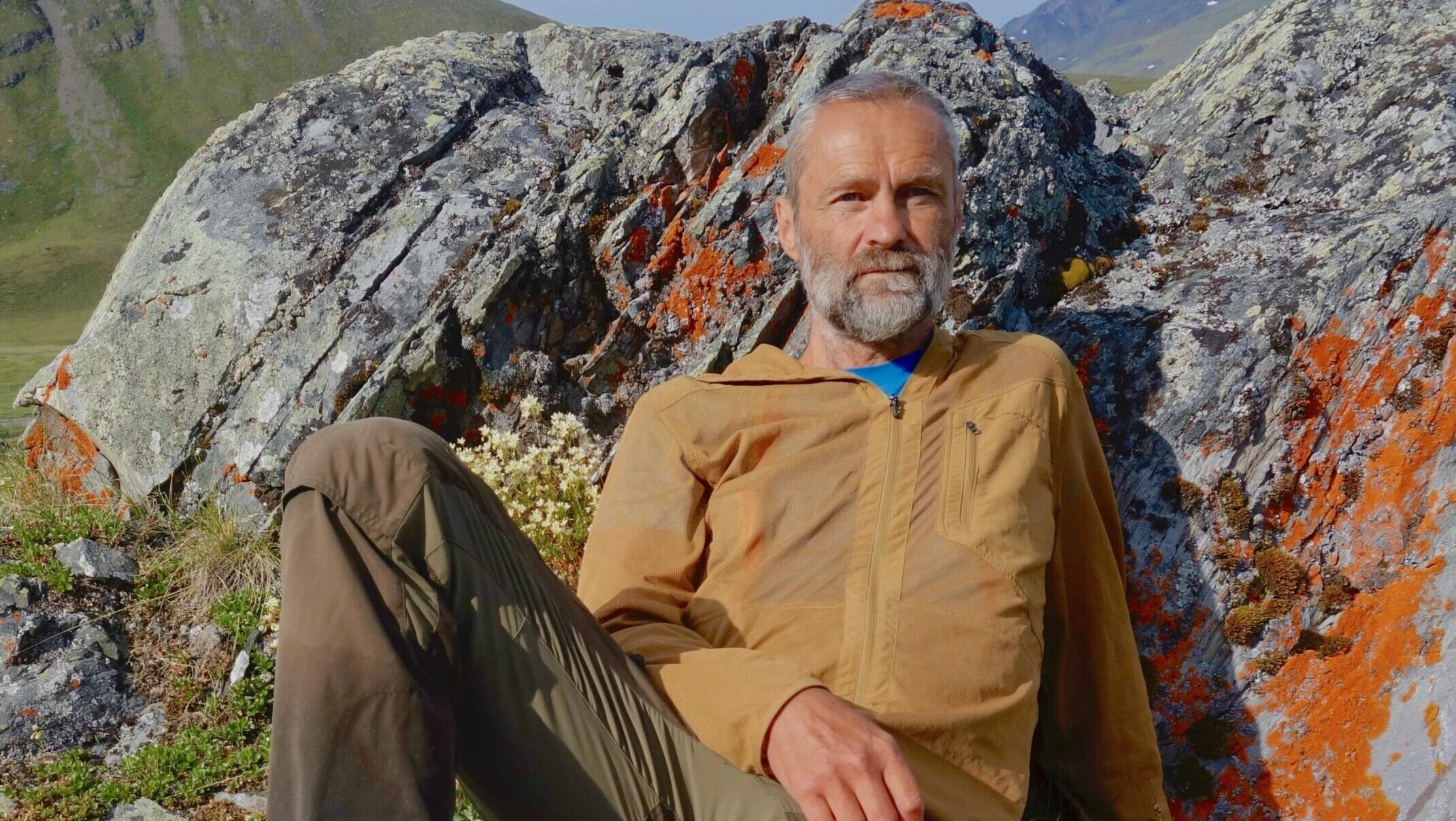
Moab author Michael Engelhard will discuss his new book about Nome, Alaska, at the Moab Arts Center on November 14 at 6 p.m. His latest work, “No Place Like Nome: The Bering Strait Seen Through Its Most Storied City,” draws on three years of living in what he calls “the most storied city I’ve ever lived in.”
“Positioned at a crossroads of continents and cultures—North America and Asia, Anglo and Iñupiaq—it is rich in characters and history dating back at least 15,000 years, when people traveled there from Beringia, the land bridge now submerged,” Engelhard said in an interview.
The 306-page book, published by Corax Books in September, explores a place that has attracted an unlikely cast of historical figures over the centuries.
From Wyatt Earp to lemming researchers
While researching the book, Engelhard discovered connections between Nome and figures ranging from photographer Edward S. Curtis to Norwegian polar explorer Roald Amundsen to Wyatt Earp, who owned a saloon there after his Tombstone days.
But it was the lesser-known characters that surprised him most.
“I discovered a colorful set of other historical figures with ties to that city and region: the nature writer Sally Carrighar—an undeservedly lesser-known Rachel Carson (she studied lemmings in her home, but Nomeites thought that she lived with rats); the Jesuit explorer-filmmaker-missionary Bernard Hubbard; and Native characters like James Kivetoruk Moses, a reindeer herder crippled in a plane crash, who took up painting scenes from Iñupiaq Eskimo daily life and history.”
The research process took about a year while writing the first draft, though Engelhard had been accumulating material through magazine articles about Nome and the Bering Strait region for years.
Comparing two remote cities
Writing from his current home in Moab gives Engelhard a unique lens for examining remote communities. “By comparing Moab to Nome—cities of a similar size—I can see commonalities as well as differences and try to figure out what accounts for those,” he explained.
Those differences often stem from “specifics in the places’ history, culture, or environment, factors that have long interested me and whose interplay I’ve explored in most of my writings.”
Both cities exist at geographical and cultural crossroads, shaped by boom-and-bust cycles and sustained by residents drawn to challenging but beautiful places.
Local connections
Engelhard’s connection to Moab runs deeper than many might expect. He typed the manuscript for his first book—an essay collection about canyons—more than 20 years ago on a computer at the Moab library when it was still at its old location.
These days, he writes from his home, specifically from what he calls his “IKEA poang, a Scandi-style Lazyboy.”
“I don’t write well in public places or even the outdoors,” said Engelhard. “but I love the library, because staff gets me rather obscure books that I need for research.”
Engelhard brings impressive credentials to his writing. His previous work has earned him three Alaska Press Club Awards and a Rasmuson Individual Artist Award. He is also the author of “Ice Bear,” a cultural history of the polar bear, and several essay collections including “What the River Knows: Essays from the Heart of Alaska.”
His memoir “Arctic Traverse” won the National Outdoor Book Award, and he has published more than a hundred articles in Alaska magazine. Copies of Engelhard’s previous books will be door prizes at the Nov. 14 event.
Beyond promoting “No Place Like Nome,” Engelhard is already working on his next project.
“I’ve been putting out feelers for a multi-artist book, edited by me, about field art (watercolor, pencil, and ink sketches) from northern Alaska.”
Appreciate the coverage? Help keep local news alive.
Chip in to support the Moab Sun News.